


Because the kidneys are deep in the torso, it is not easy to feel a lump in the kidney or see from the outside what is happening beneath the surface.
Often kidney cancer is found by accident — “an incidental finding” — when the doctor does a scan for another reason and notices something on the kidney. This is actually a good thing, as it may identify a problem early, before you even notice it. Once kidney cancer is suspected for any reason, additional tests will be needed to confirm and/or determine the extent of the disease.
The most common tests that may be ordered include:
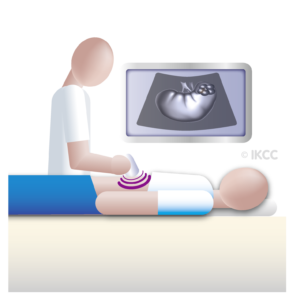
- Ultrasound: A type of scan where a probe is slid over the skin to look for irregularities in the kidney and other organs. Ultrasound is less invasive and does not involve radiation, but provides a lower resolution image than other modalities.
- CT and MRI Scans: Computed tomography (CT) scan is a series of X-ray images taken from different angles to provide cross-sectional images. Magnetic resonance imaging (MRI) scans use strong magnetic fields and radio waves to produce detailed anatomical images. CT is the preferred method in patients suspected for kidney cancer, but MRI can provide additional characterisation, and sometimes an injected dye called a contrast agent may provide clearer images to help the radiologist make a judgment.
- Chest x-ray: An x-ray of organs and bones within the chest.
- Urine test (urinalysis): The most common sign of a kidney tumour is blood in the urine. This test can also detect other irregularities in the urine such as protein.
- Blood tests: Chemical tests of the blood can detect findings associated with kidney cancer.
- Bone scan: A small amount of radioactive material is injected into a vein and travels through the bloodstream to the bones so the scanner can detect if cancer has spread to the bones.
The majority of kidney cancers are initially discovered by scans (ultrasound, CT scan, or MRI), showing something like a lump on the kidney. Sometimes your doctor may recommend immediate surgery; other times your doctor might order a biopsy. During a biopsy, a thin needle is used to remove some cells from the tumour. A pathologist will then look at the cells under the microscope to see if they are cancerous or not. Up to 20% of small kidney masses (or lumps) are non-cancerous.
